Landslide Butte fossil region
Blackfeet Reservation, northwestern Montana, United States
Two Medicine Formation
regional marker
Pronunciation: roo-bee-oh-SORE-us oh-VAY-tus
A disputed name for a partial centrosaurine frill from Montana, variously treated as Rubeosaurus, a second Styracosaurus species or Styracosaurus albertensis.
Last updated 28 July 2026
Field guide
Rubeosaurus ovatus is a useful example of how dinosaur names can change as fossils are re-examined. The name is anchored to USNM 11869, the rear part of a centrosaurine frill from the Two Medicine Formation of Montana. Charles Gilmore named it Styracosaurus ovatus in 1930 because its paired spikes curved inward. Andrew McDonald and John Horner moved it to the new genus Rubeosaurus in 2010. Later studies disagreed: one found its unusual frill within the variation of Styracosaurus albertensis, while another retained a distinct Styracosaurus ovatus. This page preserves the requested historical combination but marks it as disputed.
Its fossils occur between approximately 75.3 and 75 million years ago. Values shown here are approximate and reflect the current curated seed dataset.
Form and function
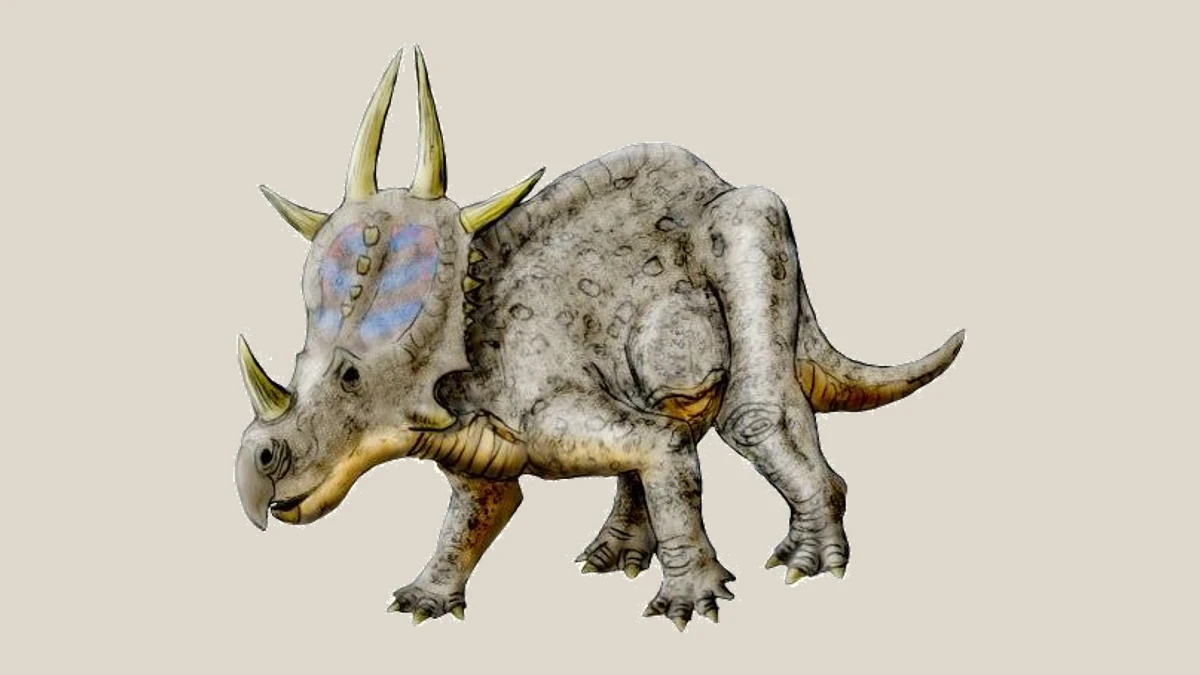
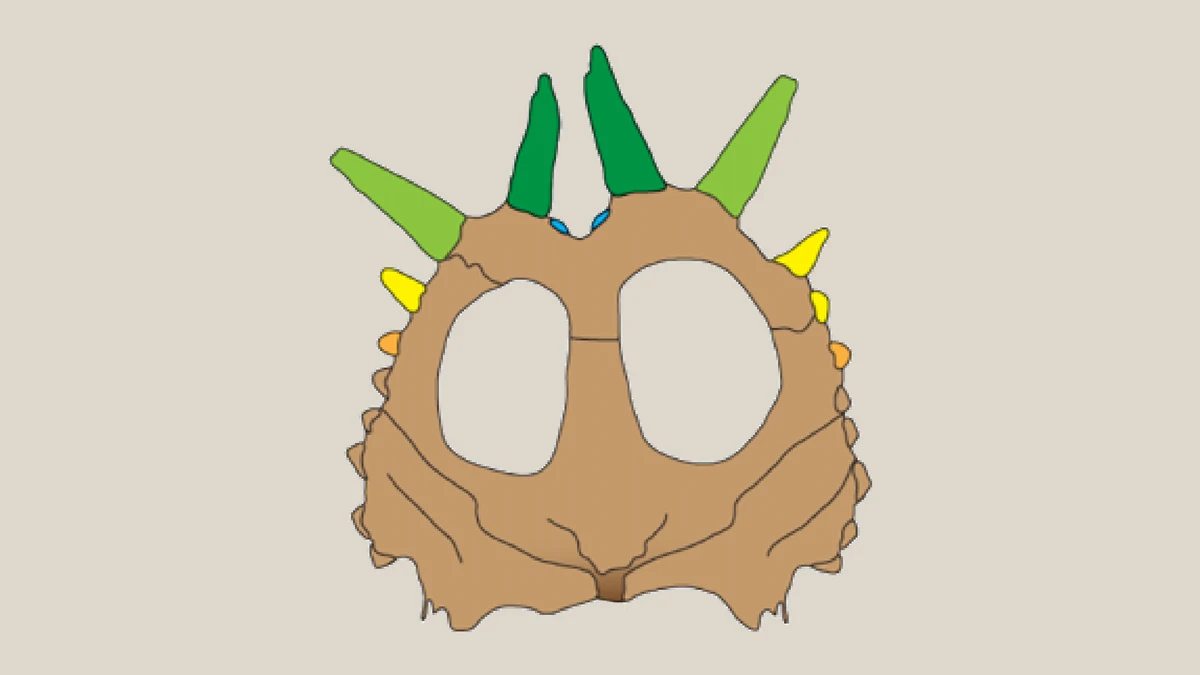
Only the rear bar of the frill can be securely assigned to the holotype. It preserves paired elongated P3 and P4 processes, including strongly inward-directed spikes that inspired the species name ovatus. Other skull and body features often shown in Rubeosaurus reconstructions came from MOR 492, but that specimen was reassigned to the separate genus Stellasaurus in 2020. A complete Rubeosaurus face, nasal horn, limbs and torso therefore remain unknown; any full-body image must combine the type frill with general Styracosaurus-like anatomy.
Evolutionary position
This simplified classification path shows one placement from Dinosauria to this species. Each step is clickable, and other analyses may support alternative relationships.
Open interactive positionScale
Simplified length comparison using preferred dataset estimates; body shape and posture are not represented.
Scientific record
Charles W. Gilmore and his field party collected USNM 11869 in 1928 from the Two Medicine Formation near Landslide Butte on the Blackfeet Reservation. Gilmore described Styracosaurus ovatus in 1930. McDonald and Horner established Rubeosaurus in 2010 and referred the more complete skull MOR 492 to it. John Wilson and colleagues showed in 2020 that MOR 492 represented Stellasaurus ancellae instead, leaving Rubeosaurus ovatus known only from its original partial frill. Robert Holmes and colleagues separately argued that the holotype falls within the variation of Styracosaurus albertensis.
Discovery credit: Charles W. Gilmore and field party.
Naming authors: Charles W. Gilmore.
Palaeoenvironment
The upper Two Medicine Formation records inland river plains east of the growing Rocky Mountains. Volcanic ash falls, seasonal droughts and episodes of heavy runoff affected a landscape supporting conifers, flowering plants, ferns and horsetails. Einiosaurus, Achelousaurus and other dinosaurs occur through the formation, but its rock sequence spans time; they should not all be treated as one simultaneous community.
Nothing about social behaviour is directly preserved with the isolated frill. A Styracosaurus-like herbivore would have cropped plants with its beak and sliced them with dental batteries, but even that reconstruction relies on close relatives. The inward-curving spikes probably supported keratin and may have contributed to display or physical interaction. Their exact living shape and function cannot be tested from this one specimen.
Worth knowing
Fossil distribution
Blackfeet Reservation, northwestern Montana, United States
Two Medicine Formation
regional marker
Markers are deliberately approximate. They identify published fossil areas without exposing sensitive excavation coordinates.
Open interactive mapFossil specimen record
Washington, D.C., United States
Repository of the original partial frill that anchors Styracosaurus ovatus and the later name Rubeosaurus ovatus. The collections record does not promise continuous public display.
A research repository is not necessarily a public exhibit. Loan and display status can change, so check with the institution before visiting.
Media record
Evidence
Robert B. Holmes, Walter Scott Persons, Baltej Singh Rupal and 2 coauthors · Cretaceous Research · 2020
Open sourceCharles W. Gilmore · Proceedings of the United States National Museum 77(16) · 1930
Open sourceAndrew T. McDonald, John R. Horner · New Perspectives on Horned Dinosaurs: The Royal Tyrrell Museum Ceratopsian Symposium · 2010
Open sourceJohn P. Wilson, Michael J. Ryan, David C. Evans · Royal Society Open Science 7, 200284 · 2020
Open sourceSmithsonian National Museum of Natural History
Open source