El Brete fossil locality
Candelaria Department, Salta Province, Argentina
Lecho Formation
regional marker
Pronunciation: SAL-tah-SORE-us lor-ih-KAH-tus
A compact Late Cretaceous titanosaur from Argentina whose associated bony plates and small dermal ossicles proved that some sauropods carried armour.
Last updated 23 July 2026
Field guide
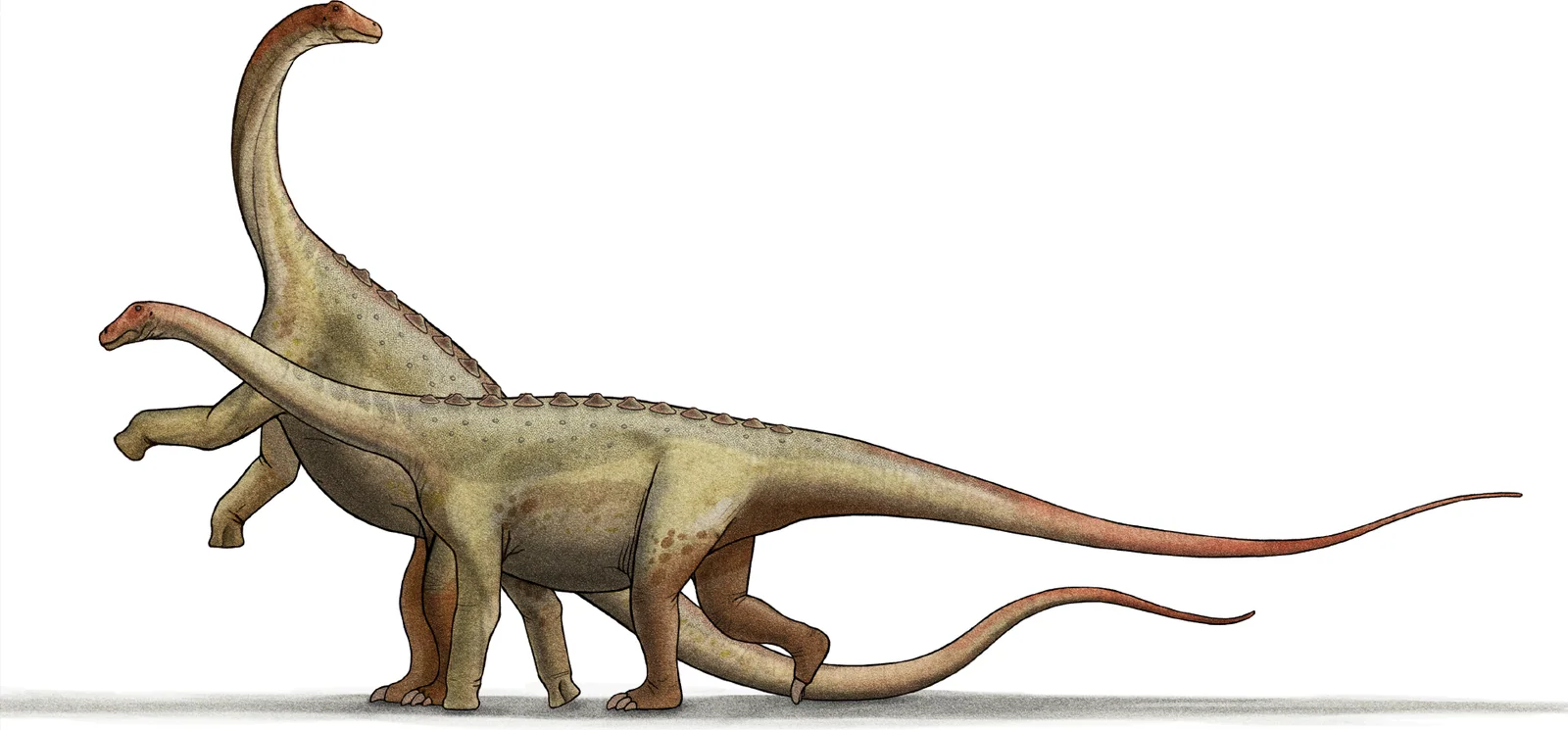
Saltasaurus loricatus was a relatively small, robust saltasaurid titanosaur from the latest Cretaceous of northwestern Argentina. More than two hundred catalogued bones from several individuals document much of the skeleton, although the holotype itself is a sacrum joined to both ilia. Saltasaurus became scientifically important because osteoderms were recovered with its skeletons, providing the first unambiguous evidence that sauropod dinosaurs could possess bony armour in their skin.
Its fossils occur between approximately 72 and 69 million years ago. Values shown here are approximate and reflect the current curated seed dataset.
Form and function
Saltasaurus had a broad body, columnar limbs, a long neck and a comparatively short, deep trunk for a sauropod. Its vertebrae were extensively hollowed by air spaces, reducing skeletal weight. The skin included relatively large bony plates as well as numerous small ossicles. Histology shows that these osteoderms formed mainly through direct mineralisation within the dermis. The exact distribution and external horny covering of the armour are not preserved, so a perfectly regular row of large scutes should not be treated as certain.
Evolutionary position
This simplified classification path shows one placement from Dinosauria to this species. Each step is clickable, and other analyses may support alternative relationships.
Open interactive positionScale
Simplified length comparison using preferred dataset estimates; body shape and posture are not represented.
Scientific record
José Bonaparte's team excavated a rich assemblage at Estancia El Brete in Salta Province between 1975 and 1977. Bonaparte and Jaime Powell named Saltasaurus loricatus in 1980. The holotype PVL 4017-92 consists of a sacrum connected to two ilia, while more than two hundred additional elements catalogued under PVL 4017 represent at least five individuals. The material belongs to the vertebrate-palaeontology collection of the Universidad Nacional de Tucumán and Instituto Miguel Lillo.
Naming authors: José F. Bonaparte, Jaime E. Powell.
Palaeoenvironment
The Lecho Formation at El Brete records continental river and floodplain environments in northwestern Argentina near the end of the Cretaceous. The site produced a mixed vertebrate assemblage including the small theropod Noasaurus and early birds. Specific plant communities and seasonal movements of Saltasaurus are not directly preserved.
Saltasaurus was a large-bodied plant eater that probably cropped vegetation with its small head and swallowed food with limited oral processing. Its osteoderms may have contributed to protection, display, mineral storage or several functions, but their exact biological role remains debated. Multiple individuals at El Brete document a population, not necessarily a herd killed together.
Worth knowing
Fossil distribution
Candelaria Department, Salta Province, Argentina
Lecho Formation
regional marker
Markers are deliberately approximate. They identify published fossil areas without exposing sensitive excavation coordinates.
Open interactive mapFossil specimen record
San Miguel de Tucumán, Argentina
Repository of the holotype PVL 4017-92 and the associated Saltasaurus material from El Brete. Continuous public display is not confirmed.
A research repository is not necessarily a public exhibit. Loan and display status can change, so check with the institution before visiting.
Media record
Evidence
José F. Bonaparte, Jaime E. Powell · Mémoires de la Société Géologique de France, Nouvelle Série 139, 19–28 · 1980
Open sourceIgnacio A. Cerda, Jaime E. Powell · Acta Palaeontologica Polonica 55(3), 389–398 · 2010
Open sourceNatural History Museum, London
Open source