Dashanpu dinosaur quarry
Zigong, Sichuan Province, China
Lower Shaximiao Formation
regional marker
Pronunciation: SHOO-no-SORE-us lee-eye
A compact, short-necked Middle Jurassic sauropod from China known from multiple excellent skeletons and a small bony club at the end of its tail.
Last updated 23 July 2026
Field guide
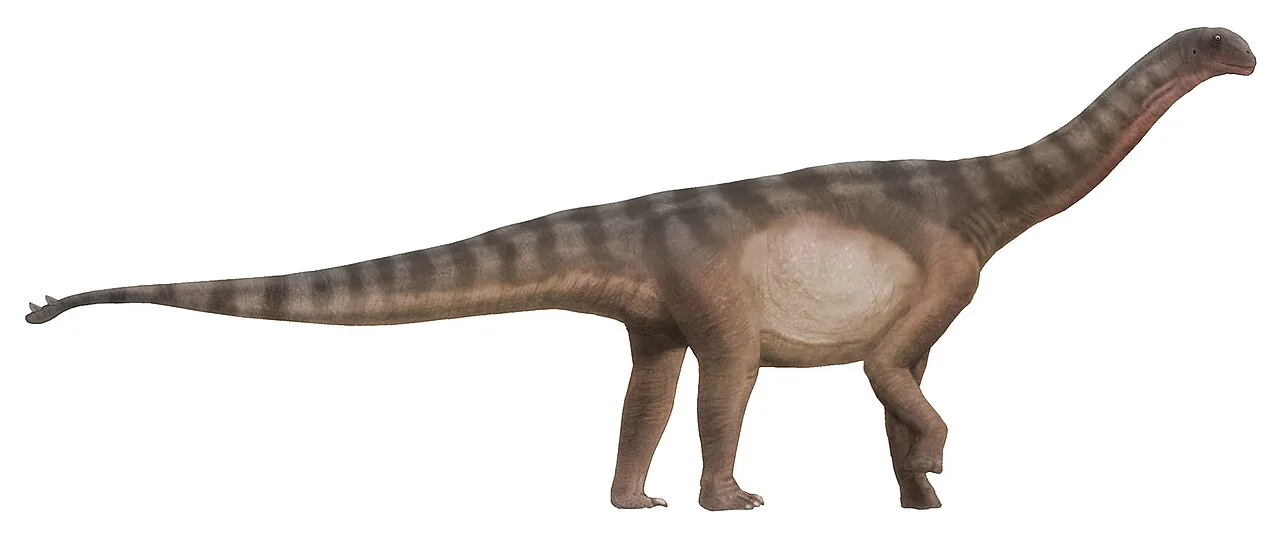
Shunosaurus lii was an early eusauropod from the Dashanpu dinosaur fauna of Sichuan. It is unusually well known for a sauropod: several skeletons preserve skulls, jaws and long runs of articulated vertebrae. The animal had a comparatively short neck, robust spoon-shaped teeth and a compact body. Distal tail vertebrae in multiple specimens are fused and expanded into a small club. Some specimens also preserve associated conical osteoderms, although the exact number, position and function of these spikes require more caution than many life restorations suggest.
Its fossils occur between approximately 168.3 and 163.5 million years ago. Values shown here are approximate and reflect the current curated seed dataset.
Form and function
The skull was short and deep with strongly upturned jaws and robust, spatulate teeth suited to cropping plants. Twelve cervical vertebrae formed a much shorter neck than in later giant sauropods. The limbs were columnar and the body broad, while the tail remained long. At its tip, several vertebrae fused and expanded into a spindle-shaped club. The original tail-club study documented multiple club specimens attributed to Shunosaurus and Omeisaurus, making the structure genuine even though the association and arrangement of separate spikes are less secure.
Evolutionary position
This simplified classification path shows one placement from Dinosauria to this species. Each step is clickable, and other analyses may support alternative relationships.
Open interactive positionScale
Simplified length comparison using preferred dataset estimates; body shape and posture are not represented.
Scientific record
The first Shunosaurus material was found near Dashanpu, outside Zigong, in 1977. Dong Zhiming, Zhou Shiwu and Zhang Yihong named Shunosaurus lii in 1983 from partial skeleton IVPP V9065. Continued quarrying produced nearly complete skeletons, skulls and tail clubs, many now held by the Zigong Dinosaur Museum. The genus uses Shu, an ancient name for Sichuan, and the species honours the historical Sichuan engineer and governor Li Bing.
Naming authors: Dong Zhiming, Zhou Shiwu, Zhang Yihong.
Palaeoenvironment
The Lower Shaximiao Formation records river channels, floodplains and lakes in the Sichuan Basin during the Middle Jurassic. Shunosaurus shared this ecosystem with the sauropods Datousaurus and Omeisaurus, the stegosaur Huayangosaurus and predatory theropods including Gasosaurus. The fossil quarry preserves many individuals, but that concentration does not by itself prove herd living.
Shunosaurus was a quadrupedal herbivore whose robust teeth could crop vegetation more forcefully than the slender peg-like teeth of many later sauropods. Its bony tail tip could plausibly have served in defence, but no impact damage or observed behaviour proves how it was swung. Claims about herding, lifespan, feeding height or social use of the club remain hypotheses rather than direct observations.
Worth knowing
Fossil distribution
Zigong, Sichuan Province, China
Lower Shaximiao Formation
regional marker
Markers are deliberately approximate. They identify published fossil areas without exposing sensitive excavation coordinates.
Open interactive mapFossil specimen record
Zigong, China
The museum preserves several referred skeletons and skulls from Dashanpu, including material central to the anatomical and tail-club descriptions.
A research repository is not necessarily a public exhibit. Loan and display status can change, so check with the institution before visiting.
Media record
Evidence
Dong Zhiming, Zhou Shiwu, Zhang Yihong · Palaeontologia Sinica, New Series C 162(23) · 1983
Open sourceDong Zhiming, Peng Guangzhao, Huang Daxi · Vertebrata PalAsiatica 27(3), 219–224 · 1989
Open sourceSankar Chatterjee, Zhong Zheng · Zoological Journal of the Linnean Society 136(1), 145–169 · 2002
Open sourceZigong Dinosaur Museum
Open source