Zhucheng fossil region
Shandong Province, China
Xingezhuang Formation, Wangshi Group
regional marker
Pronunciation: SY-no-SER-ah-tops zhoo-cheng-EN-sis
The first named ceratopsid from China, distinguished by a large skull ringed with numerous curved frill processes.
Last updated 28 July 2026
Field guide
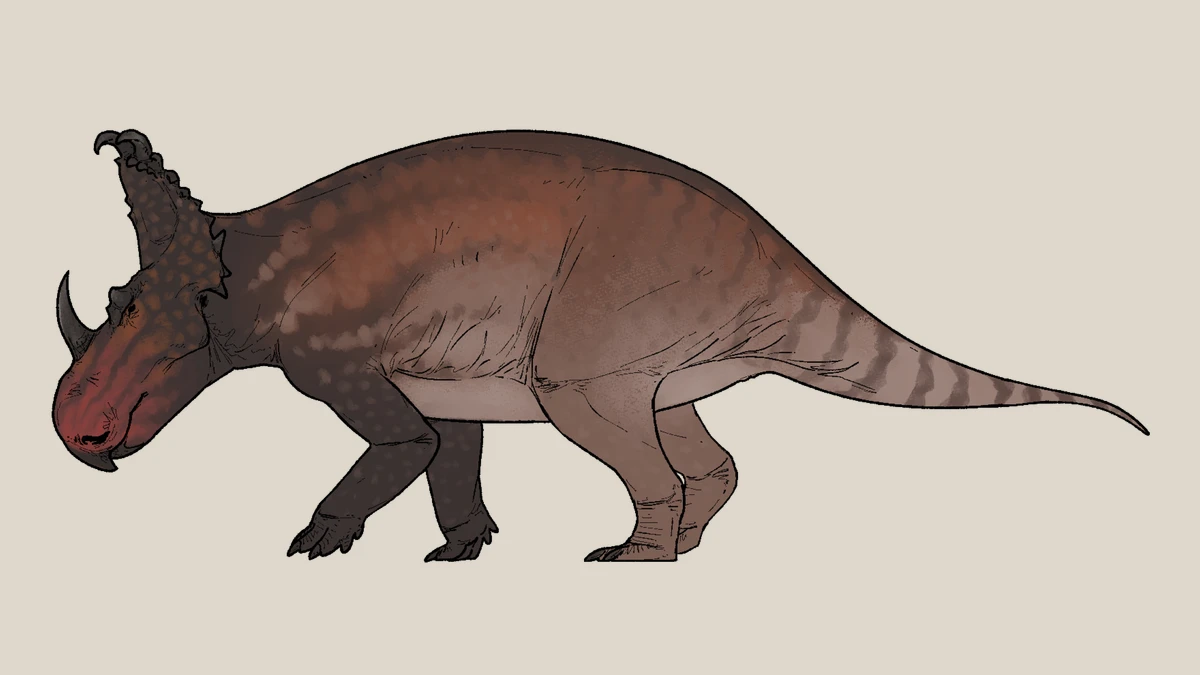
Sinoceratops zhuchengensis was a large centrosaurine from the Upper Cretaceous Wangshi Group of Shandong. Its 2010 description provided the first secure ceratopsid record outside North America and changed ideas about the group’s geographic history. The known fossils are skull material rather than complete skeletons, but they reveal an unusual combination: a modest nasal horn, rough bosses above the eyes and nose, and many robust ornaments around a broad frill.
Its fossils occur between approximately 74 and 72 million years ago. Values shown here are approximate and reflect the current curated seed dataset.
Form and function
The holotype skull was estimated at about 1.8 metres long. At least ten strongly curved horn-like processes line the rear edge of the parietals and at least four more occur on each squamosal. Broad-based marginal ossifications, low bosses over the eyes and nose, and an accessory opening in front of the reduced antorbital fenestra distinguish the skull. The body is reconstructed from other ceratopsids because no comparably complete postcranial skeleton has been described.
Evolutionary position
This simplified classification path shows one placement from Dinosauria to this species. Each step is clickable, and other analyses may support alternative relationships.
Open interactive positionScale
Simplified length comparison using preferred dataset estimates; body shape and posture are not represented.
Scientific record
A large quarry opened near Zangjiazhuang, Zhucheng, in 2008 and produced abundant dinosaur bones, mostly hadrosaur material, together with distinctive ceratopsid skull pieces. Xing Xu, Kebai Wang, Xijin Zhao and Dunjing Li named Sinoceratops zhuchengensis in 2010. The holotype, ZCDM V0010, is a partial skull held by the Zhucheng Dinosaur Museum; ZCDM V0011 and V0012 preserve additional cranial material.
Discovery credit: Zhucheng field teams.
Naming authors: Xing Xu, Kebai Wang, Xijin Zhao, Dunjing Li.
Palaeoenvironment
The Zhucheng deposits record a river-influenced coastal plain in eastern Asia. Sinoceratops lived alongside giant hadrosaurs such as Shantungosaurus and large predators including Zhuchengtyrannus. The displayed age range is intentionally broad because correlation within the Wangshi Group remains less precise than for many North American ceratopsid sites.
Its beak and dental batteries identify a plant eater capable of cropping and slicing tough vegetation. The conspicuous frill border and facial bosses probably had a visual role, although defence and physical interaction cannot be excluded. Several skulls show the animal was not represented by only one individual, but they do not demonstrate permanent herding or a particular social system.
Worth knowing
Fossil distribution
Shandong Province, China
Xingezhuang Formation, Wangshi Group
regional marker
Markers are deliberately approximate. They identify published fossil areas without exposing sensitive excavation coordinates.
Open interactive mapFossil specimen record
Zhucheng, China
Repository of holotype ZCDM V0010 and referred skull material ZCDM V0011–V0012. Gallery arrangements may change.
A research repository is not necessarily a public exhibit. Loan and display status can change, so check with the institution before visiting.
Media record
Evidence
Xing Xu, Kebai Wang, Xijin Zhao, Dunjing Li · Chinese Science Bulletin 55(16), 1631–1635 · 2010
Open sourceInstitute of Vertebrate Paleontology and Paleoanthropology, Chinese Academy of Sciences
Open source