Bahariya Oasis
Western Desert, Egypt
Bahariya Formation
regional marker
Pronunciation: spy-no-SORE-us ee-jip-TY-ah-kus
A giant North African spinosaurid with an elongated, narrow snout, conical teeth, towering neural spines and a deep, fin-like tail. How much time it spent swimming remains actively debated.
Last updated 12 July 2026
Field guide
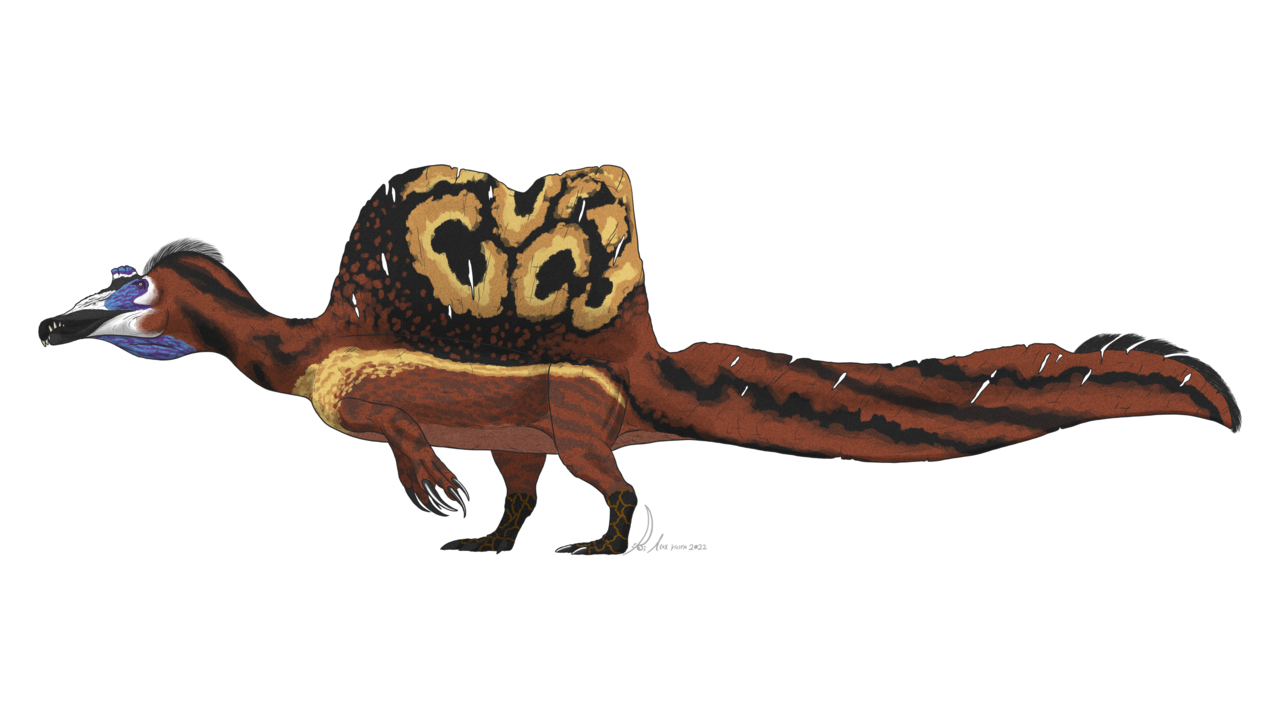
Spinosaurus aegyptiacus lived in northern Africa during the Cenomanian age of the Late Cretaceous. It is one of the largest known predatory dinosaurs, but no complete skeleton is known and its proportions have repeatedly changed as new material has been described. The animal combined a long, fish-catching skull with powerful forelimbs, an immense dorsal sail and an unusually deep tail. These features clearly connect it with waterside habitats, although researchers disagree over whether it pursued prey underwater or foraged mainly in shallow water and along shorelines.
Its fossils occur between approximately 100.5 and 93.9 million years ago. Values shown here are approximate and reflect the current curated seed dataset.
Form and function
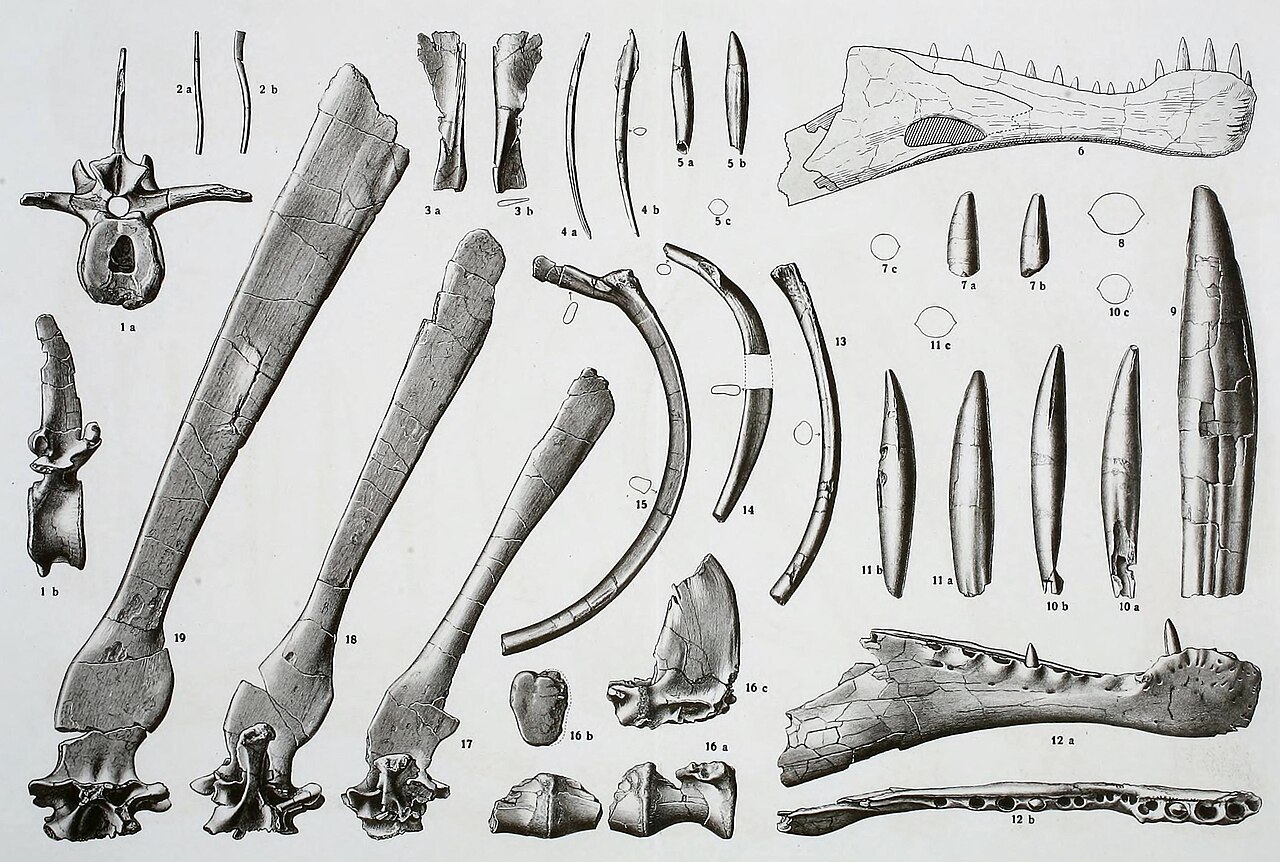
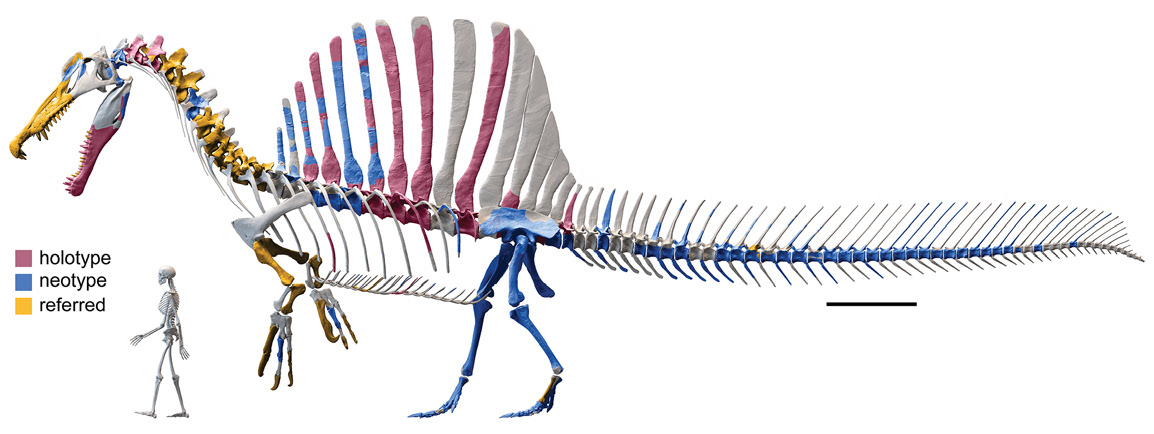
The reconstruction is a composite scientific hypothesis. The Egyptian holotype preserves parts of the skull, vertebral column and ribs; Moroccan material supplies much of the limb, pelvic and tail anatomy used in modern restorations. Because the association and identity of some Moroccan bones have been challenged, the exact body plan is less certain than the familiar silhouette suggests.
Evolutionary position
This simplified classification path shows one placement from Dinosauria to this species. Each step is clickable, and other analyses may support alternative relationships.
Open interactive positionScale
Simplified length comparison using preferred dataset estimates; body shape and posture are not represented.
Scientific record
Richard Markgraf found the first confidently referable skeleton in Egypt's Bahariya Oasis in 1912. Ernst Stromer named Spinosaurus aegyptiacus in 1915 from holotype BSP 1912 VIII 19. The fossils were kept in Munich and destroyed during an Allied bombing raid on 24–25 April 1944; Stromer's published plates, notes and surviving photographs are therefore crucial evidence. A partial Moroccan skeleton, FSAC-KK-11888, was described in 2014 after its locality was relocated. It was proposed as a neotype, but both that designation and the specimen's taxonomic assignment have been disputed.
Discovery credit: Richard Markgraf.
Naming authors: Ernst Stromer.
Palaeoenvironment
Known from river-dominated environments in what are now Egypt and Morocco. These Cenomanian systems supported abundant fish, crocodyliforms, turtles, pterosaurs and several large theropods. The Moroccan material assigned to this species comes from the Kem Kem Group; the holotype came from the Bahariya Formation.
Its snout and teeth are well suited to seizing slippery prey, and direct evidence from related spinosaurs confirms that fish formed part of the family's diet. Spinosaurus probably also took terrestrial prey opportunistically. A deep tail and dense bones have been used to argue for underwater foraging, while buoyancy and biomechanical studies have instead supported a shoreline or shallow-water generalist. The website presents this as an open scientific question, not a settled fact.
Worth knowing
Fossil distribution
Western Desert, Egypt
Bahariya Formation
regional marker
Southeastern Morocco, Morocco
Kem Kem Group / Douira Formation
regional marker
Markers are deliberately approximate. They identify published fossil areas without exposing sensitive excavation coordinates.
Open interactive mapFossil specimen record
Munich, Germany
Historical repository of holotype BSP 1912 VIII 19. The original fossils were destroyed during the bombing of Munich in April 1944; this is a historical collection record, not a surviving exhibit.
Casablanca, Morocco
Research repository for partial skeleton FSAC-KK-11888, proposed as a neotype in 2014. Its neotype status and assignment have been disputed; public display is not confirmed.
A research repository is not necessarily a public exhibit. Loan and display status can change, so check with the institution before visiting.
Media record
Evidence
Ernst Stromer · Abhandlungen der Königlich Bayerischen Akademie der Wissenschaften · 1915
Joshua B. Smith, Matthew C. Lamanna, Kenneth J. Lacovara · Journal of Paleontology · 2006
Open sourceCristiano Dal Sasso, Simone Maganuco, Eric Buffetaut, Marco A. Mendez · Journal of Vertebrate Paleontology · 2005
Open sourceNizar Ibrahim, Paul C. Sereno, Cristiano Dal Sasso · Science · 2014
Open sourceSerjoscha W. Evers, Oliver W. M. Rauhut, Angela C. Milner · PeerJ · 2015
Open sourceNizar Ibrahim, Simone Maganuco, Cristiano Dal Sasso · Nature · 2020
Open sourceDavid W. E. Hone, Thomas R. Holtz Jr. · Palaeontologia Electronica · 2021
Open sourceMatteo Fabbri, Guillermo Navalón, Roger B. J. Benson · Nature · 2022
Open sourcePaul C. Sereno, Nathan P. Myhrvold, Donald M. Henderson, Frank E. Fish · eLife · 2022
Open sourceNearby branches