Jenguebi–Iguidi fossil region
Central Sahara, Niger
Farak and Echkar formations
regional marker
Pronunciation: spy-no-SORE-us mee-RAH-bee-lis
A newly named Spinosaurus species from Niger, recognised by a tall, scimitar-shaped crest above the skull roof. It is known only from immature, incomplete individuals.
Last updated 12 July 2026
Field guide
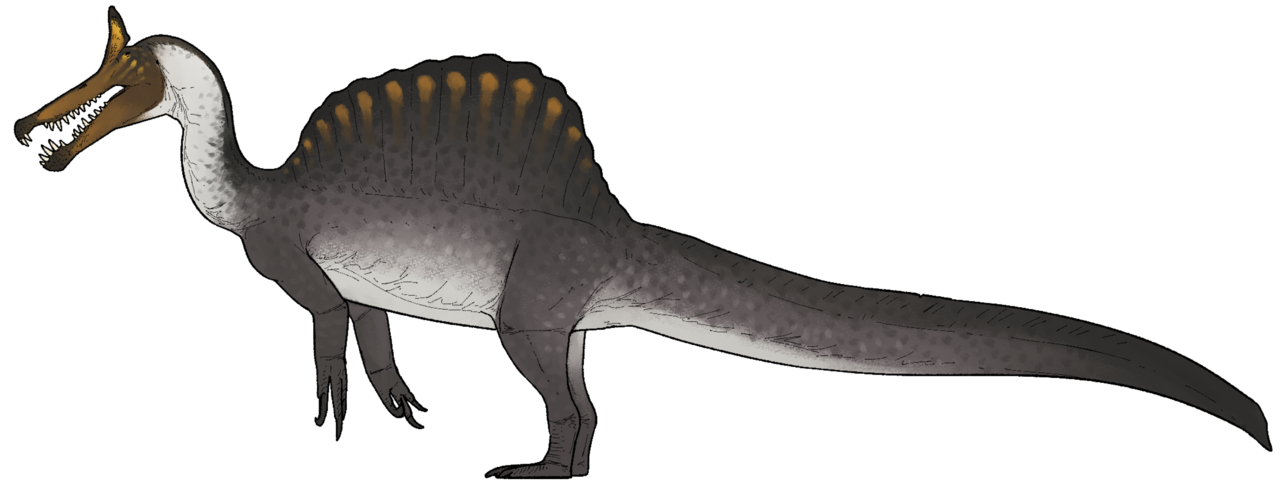
Spinosaurus mirabilis was formally described in 2026 from Cenomanian rocks of the central Sahara in Niger. Its most striking feature is a tall nasal-prefrontal crest that curves backward like a scimitar and bears vascular grooves, suggesting that a keratin covering may have enlarged it in life. The fossils were recovered from riparian deposits alongside long-necked dinosaurs. In the describing analysis it is the sister species of Spinosaurus aegyptiacus, but its known sample consists only of immature individuals and much of the adult skeleton remains unknown.
Its fossils occur between approximately 100.5 and 93.9 million years ago. Values shown here are approximate and reflect the current curated seed dataset.
Form and function
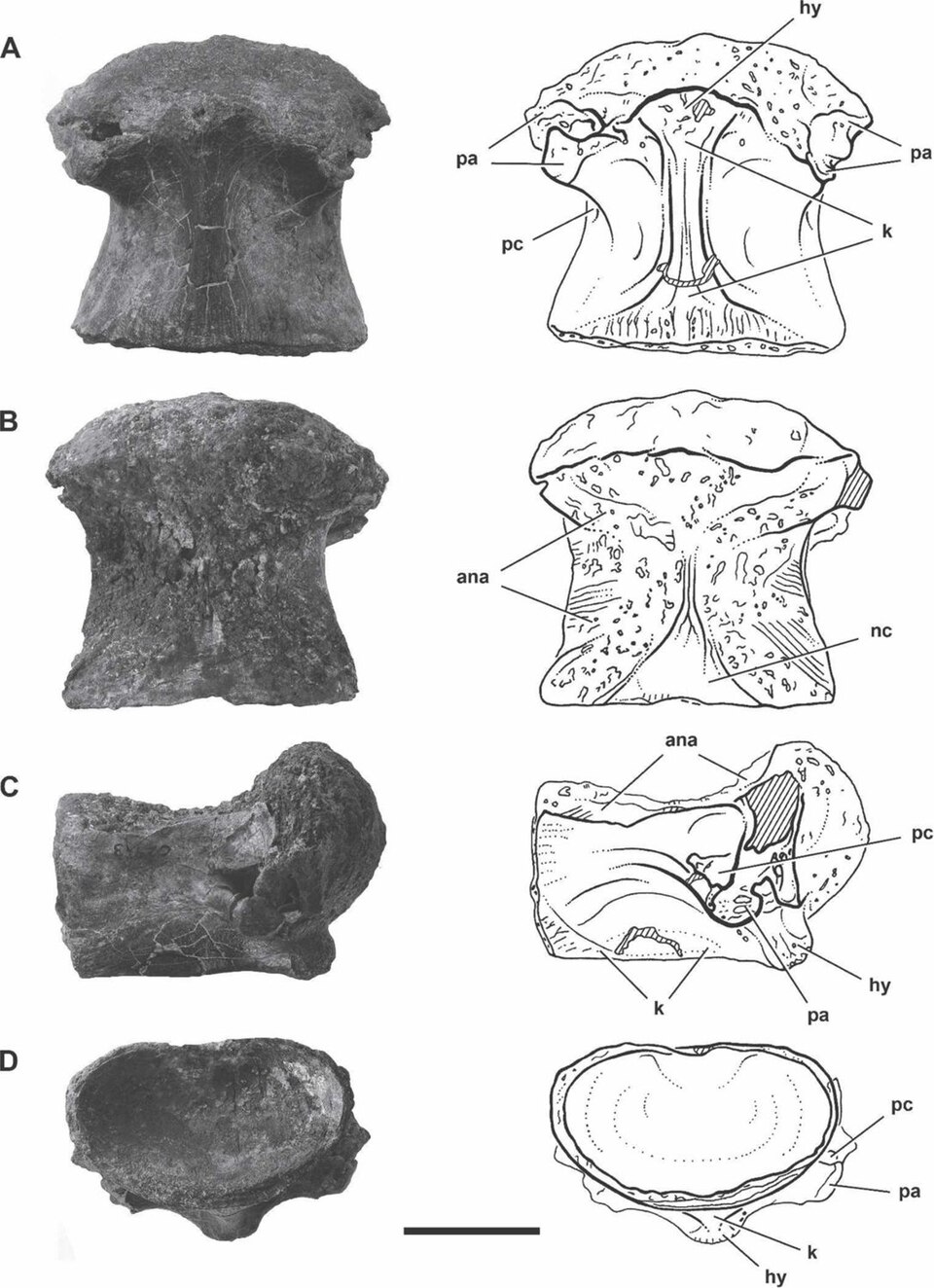
The holotype is a subadult represented mainly by a fragmentary skull and teeth. Referred specimens add isolated cranial and postcranial bones, including vertebral and foot material. Reconstructions therefore combine directly preserved anatomy, traits shared with S. aegyptiacus and explicitly labelled inference; the adult proportions, mass and final crest size cannot yet be measured.
Evolutionary position
This simplified classification path shows one placement from Dinosauria to this species. Each step is clickable, and other analyses may support alternative relationships.
Open interactive positionScale
Simplified length comparison using preferred dataset estimates; body shape and posture are not represented.
Scientific record
Paul Sereno-led teams excavated material at Iguidi and Jenguebi in Niger during field seasons in 2000, 2019 and 2022. The holotype, MNBH JEN1 from Jenguebi, includes parts of the snout and lower jaw, the diagnostic crest and teeth. Sereno and 28 coauthors named the species on 19 February 2026. The name mirabilis means 'astonishing' and refers to the enlarged nasal-prefrontal crest.
Discovery credit: Paul C. Sereno-led field teams.
Naming authors: Paul C. Sereno, Daniel Vidal, Nathan P. Myhrvold and 26 coauthors.
Palaeoenvironment
The Jenguebi fossils came from the Farak Formation, interpreted as a river-margin or riparian setting in the central Sahara. The describing paper reports S. mirabilis living alongside long-necked dinosaurs. Referred Iguidi material comes from Cenomanian deposits of the Echkar Formation.
The authors interpreted derived spinosaurines as large, shallow-water ambush specialists. The crest was probably a visual display structure, but sex, colour and exact function cannot be recovered from the fossils. No direct evidence establishes its social behaviour, swimming performance or complete diet.
Worth knowing
Fossil distribution
Central Sahara, Niger
Farak and Echkar formations
regional marker
Markers are deliberately approximate. They identify published fossil areas without exposing sensitive excavation coordinates.
Open interactive mapFossil specimen record
Niamey, Niger
Research repository for holotype MNBH JEN1 and the Jenguebi specimen series. This record identifies scientific custody and does not confirm a public exhibit.
Chicago, United States
Some Iguidi material was reported as temporarily on research loan here at the time of the 2026 description. Loan status can change and public display is not confirmed.
A research repository is not necessarily a public exhibit. Loan and display status can change, so check with the institution before visiting.
Media record
Evidence
Paul C. Sereno, Nathan P. Myhrvold, Donald M. Henderson, Frank E. Fish · eLife · 2022
Open sourcePaul C. Sereno, Daniel Vidal, Nathan P. Myhrvold and 3 coauthors · Science · 2026
Open sourceU.S. National Library of Medicine · 2026
Open sourceNearby branches