Dinosaur Provincial Park region
Alberta, Canada
Dinosaur Park Formation
regional marker
Pronunciation: sty-RAK-oh-SORE-us al-ber-TEN-sis
A centrosaurine horned dinosaur from the upper Dinosaur Park Formation, distinguished by a huge nasal horn and long spikes around its frill. Several skulls show that the celebrated frill pattern varied—and could be strongly asymmetric—between individuals.
Last updated 13 July 2026
Field guide
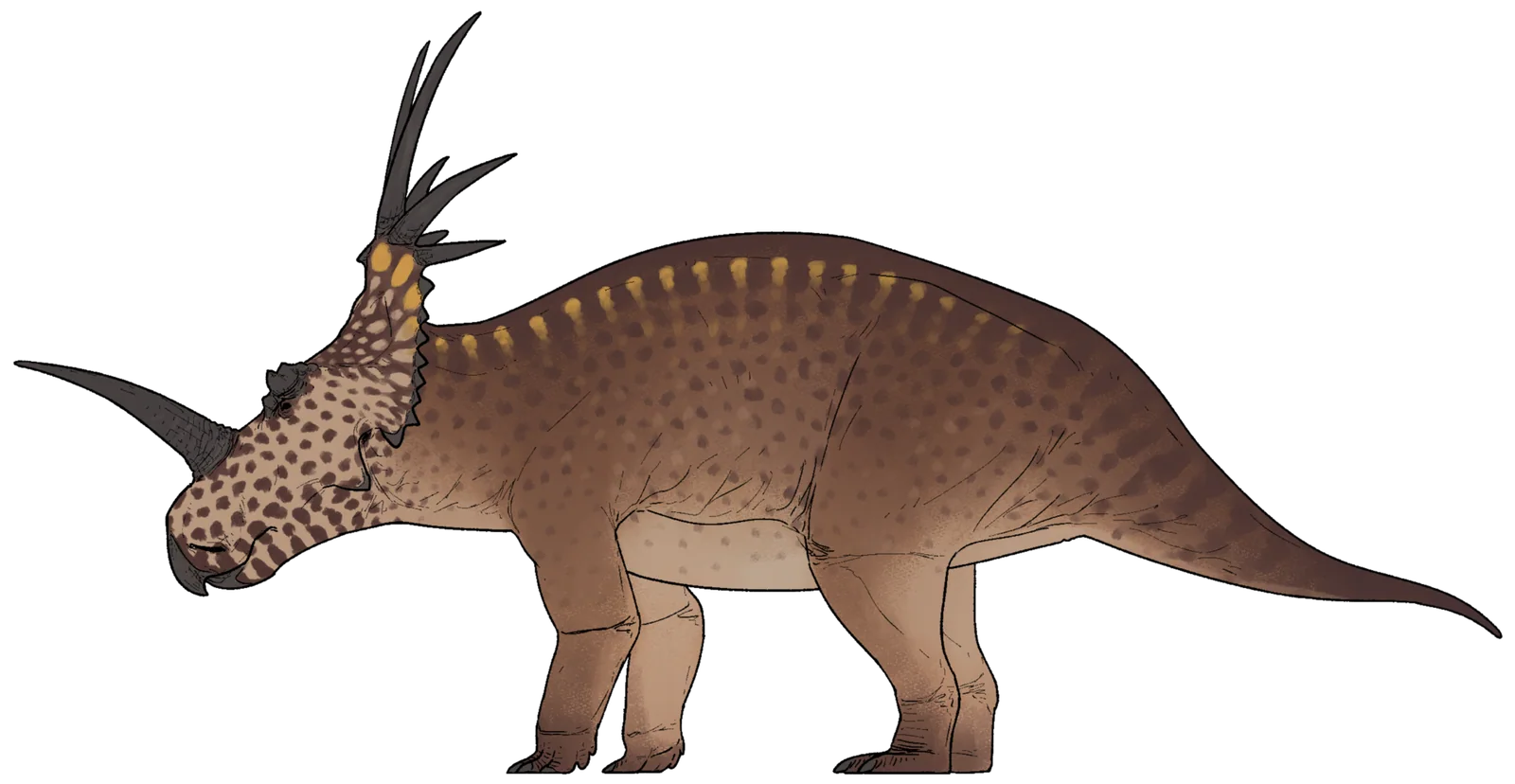
Styracosaurus albertensis was a stocky, four-legged ceratopsid that lived on the coastal plains of southern Alberta late in the Campanian. Its combination of a massive nasal horn, small brow horns and elongated parietal spikes produced one of the most distinctive dinosaur skulls. A beak and dense batteries of slicing cheek teeth processed tough plants. The holotype includes a largely complete skull and most of the postcranial skeleton, while later skulls, skeletons and bonebed material reveal growth and individual variation. Modern work shows that no single perfectly symmetrical frill pattern defines every member of the species.
Its fossils occur between approximately 75.3 and 74.8 million years ago. Values shown here are approximate and reflect the current curated seed dataset.
Form and function
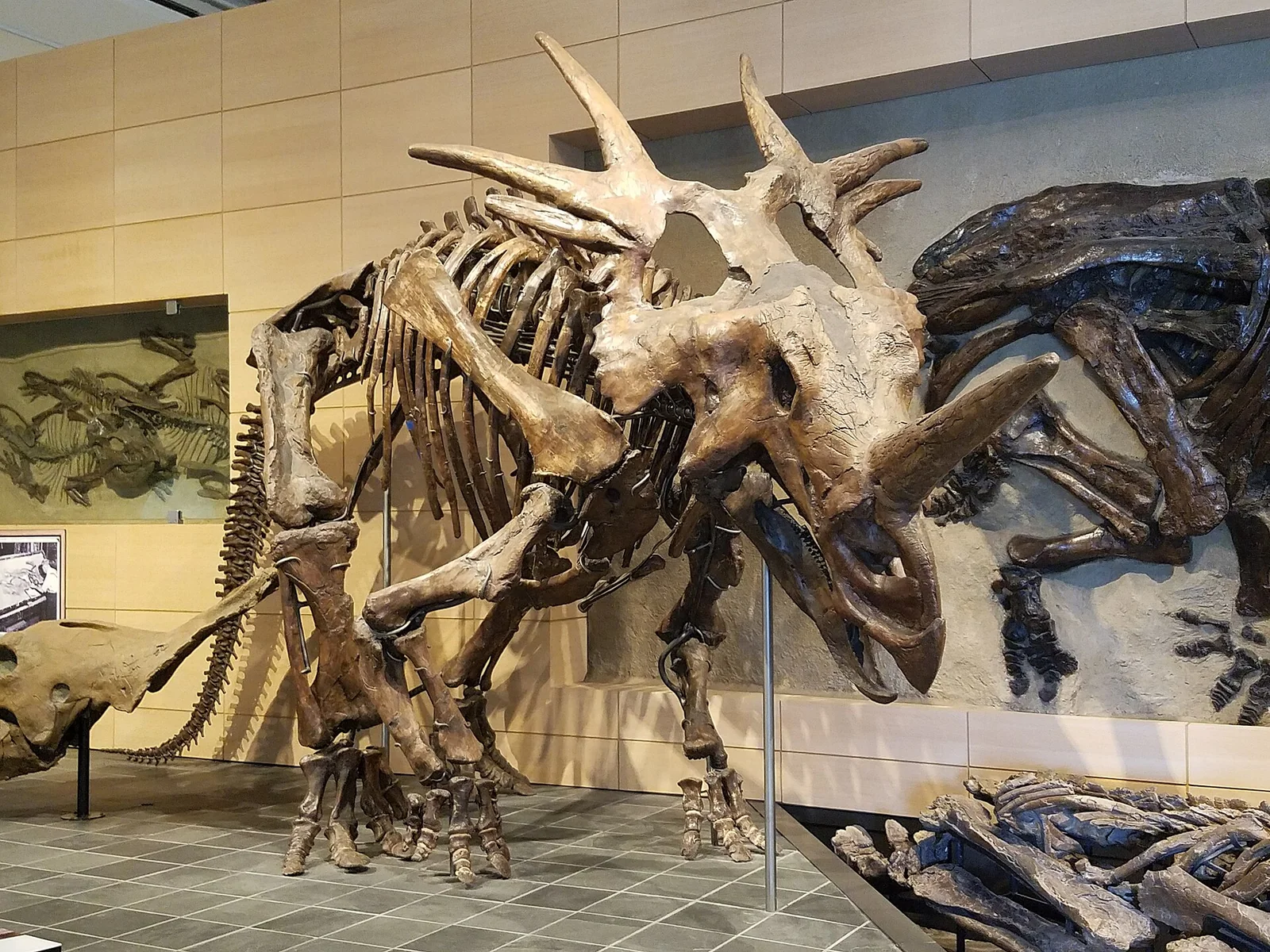
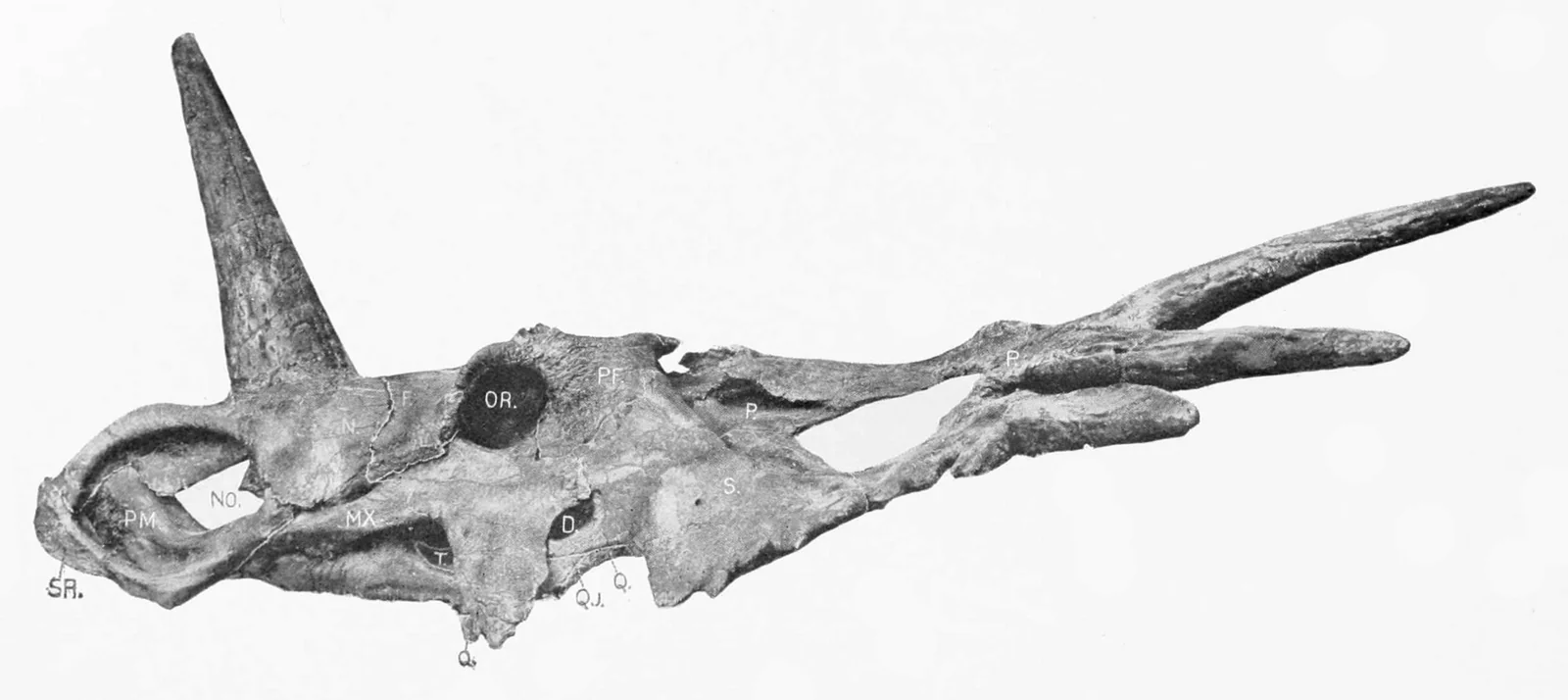
The deep skull ended in a narrow, toothless beak backed by stacked dental batteries. A long nasal horn rose above the snout, while the brow horns were reduced compared with Triceratops. The parietosquamosal frill carried long spike-like epiossifications, usually with the largest projecting back and outward; their size, curvature, position and even number could differ between the two sides of one skull. A short, robust neck and powerful forequarters supported the heavy head. The barrel-shaped body stood on four columnar limbs, with hoof-like terminal bones on the main digits.
Evolutionary position
This simplified classification path shows one placement from Dinosauria to this species. Each step is clickable, and other analyses may support alternative relationships.
Open interactive positionScale
Simplified length comparison using preferred dataset estimates; body shape and posture are not represented.
Scientific record
Charles H. Sternberg discovered the skull of holotype CMN 344 in 1913 beside the Red Deer River in what is now Dinosaur Provincial Park. Lawrence M. Lambe described and illustrated it that December as Styracosaurus albertensis. Associated postcranial bones recovered later supplied most of the body skeleton now catalogued with the type. Further discoveries include AMNH 5372, once named Styracosaurus parksi, a nearly complete referred skeleton TMP 1989.097.1, small immature individuals and material from a multi-taxic bonebed. Together they changed Styracosaurus from a species reconstructed mainly from one skull into a sample that records growth and striking individual variation.
Discovery credit: Charles H. Sternberg.
Naming authors: Lawrence M. Lambe.
Palaeoenvironment
Styracosaurus is known from the upper Dinosaur Park Formation, deposited on a warm coastal plain east of the rising Rocky Mountains and west of the Western Interior Seaway. Rivers repeatedly flooded low forests, wetlands and poorly drained floodplains. Lambeosaurus and Prosaurolophus characterize the same upper assemblage zone, while armoured dinosaurs, small theropods and large tyrannosaurids occupied the broader ecosystem.
The beak cropped vegetation and the dental batteries sliced it before swallowing; exact preferred plants and feeding height are not known. The horn-and-frill complex could have contributed to visual display, species recognition, defence or combat, and these functions need not be exclusive. A bonebed containing Styracosaurus remains shows that multiple individuals could be associated at death, but it does not prove permanent herding. Variation and asymmetry in the frill also caution against assuming every ornament carried one rigid species-recognition signal.
Worth knowing
Fossil distribution
Alberta, Canada
Dinosaur Park Formation
regional marker
Markers are deliberately approximate. They identify published fossil areas without exposing sensitive excavation coordinates.
Open interactive mapFossil specimen record
Ottawa, Canada
CMNFV 344, the original name-bearing individual, is curated by the museum and remains a current visitor highlight. The exhibition mount incorporates casts and restoration around the fossil evidence, while the research collection preserves the largely complete skull and much of the postcranial skeleton.
A research repository is not necessarily a public exhibit. Loan and display status can change, so check with the institution before visiting.
Media record
Evidence
Canadian Museum of Nature
Open sourceLawrence M. Lambe · The Ottawa Naturalist · 1913
Open sourceMichael J. Ryan, Robert Holmes, Anthony P. Russell · Journal of Vertebrate Paleontology · 2007
Open sourceRobert B. Holmes, Michael J. Ryan · Kirtlandia · 2013
Open sourceRobert B. Holmes, Walter Scott Persons, Baltej Singh Rupal and 2 coauthors · Cretaceous Research · 2020
Open sourceCaleb M. Brown, Robert B. Holmes, Philip J. Currie · Vertebrate Anatomy Morphology Palaeontology · 2020
Open sourceCanadian Museum of Nature · 2025
Open sourceUNESCO World Heritage Centre
Open source