Hell Creek fossil region
Eastern Montana, United States
Hell Creek Formation
regional marker
Pronunciation: try-SERR-ah-tops HOR-id-us
A massive latest-Cretaceous herbivore with a parrot-like beak, continuously replacing dental batteries, two long brow horns, a nasal horn and a solid bony frill. It lived alongside Tyrannosaurus during the final two million years of the dinosaur age.
Last updated 13 July 2026
Field guide
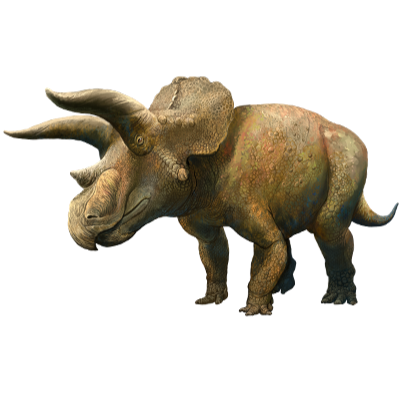
Triceratops horridus was one of the largest ceratopsids and one of the most abundant large herbivores in the lower and middle Hell Creek Formation. Its enormous skull carried a short nasal horn, two elongated brow horns and a solid frill edged by small bones called epiossifications. A deep beak cropped vegetation, while vertical batteries of tightly packed teeth sliced it. Many skulls and isolated bones are known, but genuinely associated, substantially complete skeletons remain much rarer than the familiar museum mounts suggest.
Its fossils occur between approximately 68 and 66 million years ago. Values shown here are approximate and reflect the current curated seed dataset.
Form and function
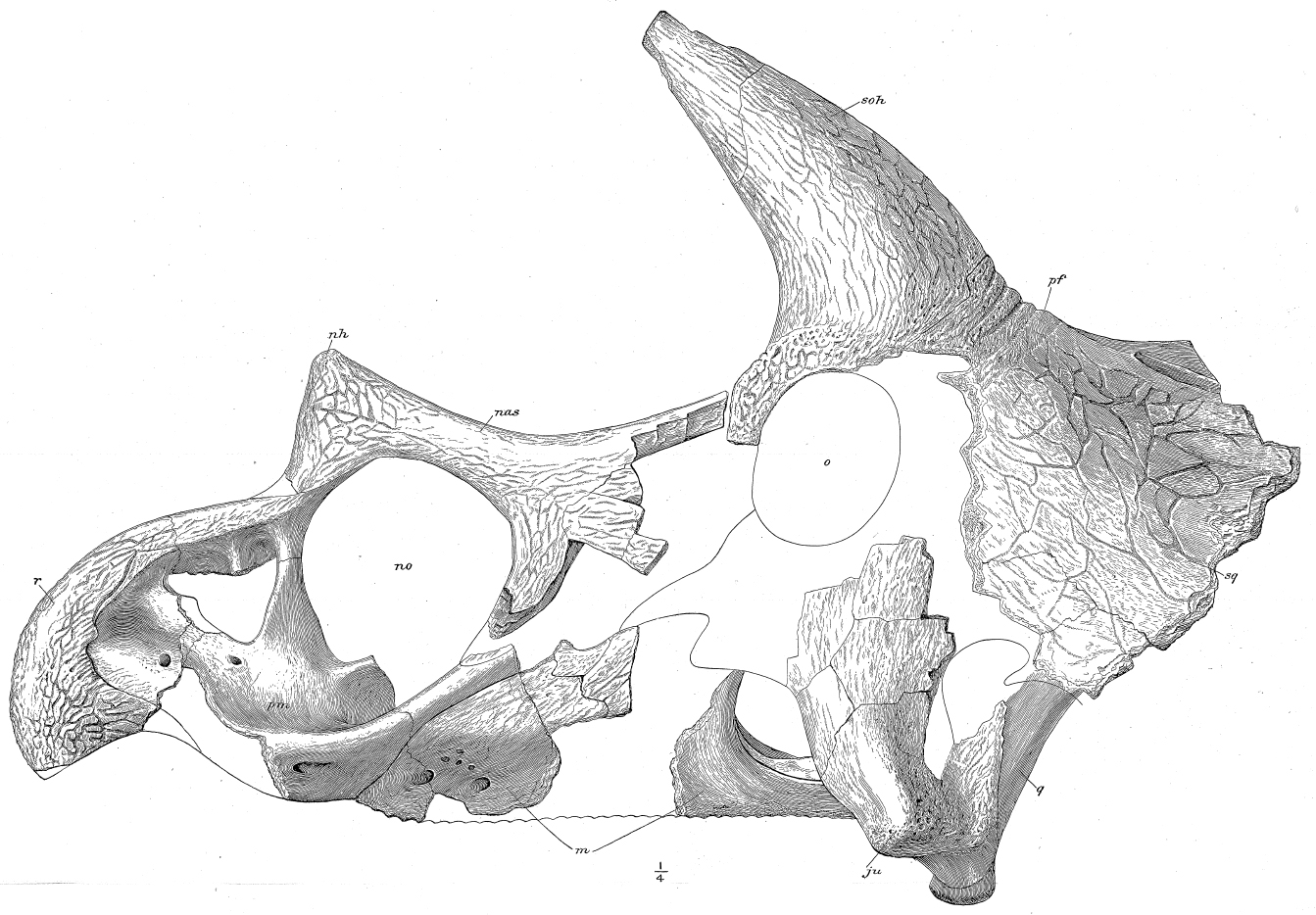
The skull could approach one third of total body length. Its beak and dental batteries formed a two-stage feeding system: the beak cropped plants and columns of continually replacing teeth sheared them. The frill was solid rather than pierced by the large openings seen in Torosaurus. Horn direction and frill-edge bones changed dramatically during growth, so juvenile, subadult and adult skulls can look surprisingly different. The hands bore five digits but only the inner three primarily supported weight; the hind feet had four toes.
Evolutionary position
This simplified classification path shows one placement from Dinosauria to this species. Each step is clickable, and other analyses may support alternative relationships.
Open interactive positionScale
Simplified length comparison using preferred dataset estimates; body shape and posture are not represented.
Scientific record
John Bell Hatcher collected the type skull YPM 1820 from the Lance Formation of Wyoming in 1888. Othniel Charles Marsh first called it Ceratops horridus early in 1889, then recognised its distinctive third horn and established the new genus Triceratops that August. The species name horridus means rough or rugged, referring to the type material's surface. Hatcher's extensive field work supplied much of the material used in The Ceratopsia, completed after his death and published by the U.S. Geological Survey in 1907.
Discovery credit: John Bell Hatcher.
Naming authors: Othniel Charles Marsh.
Palaeoenvironment
T. horridus inhabited warm, humid coastal lowlands crossed by rivers and floodplains near the western margin of the Western Interior Seaway. Hell Creek and Lance landscapes supported flowering plants, conifers, ferns and palms or palm-like plants. Edmontosaurus, Thescelosaurus, Ankylosaurus, small mammals, turtles, crocodilians and Tyrannosaurus shared parts of this latest-Cretaceous ecosystem.
The beak and dental batteries made Triceratops an efficient bulk herbivore, but exact preferred plants are unknown. Horns and frills could contribute to defence, visual display, species recognition and combat between individuals; healed lesions and growth changes are informative without proving one exclusive function. Most discoveries are isolated. Rare multi-individual sites—including five T. horridus individuals found together by Naturalis—show that groups sometimes formed or died together, but do not establish permanent herds with a particular social structure.
Worth knowing
Fossil distribution
Eastern Montana, United States
Hell Creek Formation
regional marker
Markers are deliberately approximate. They identify published fossil areas without exposing sensitive excavation coordinates.
Open interactive mapFossil specimen record
Washington, D.C., United States
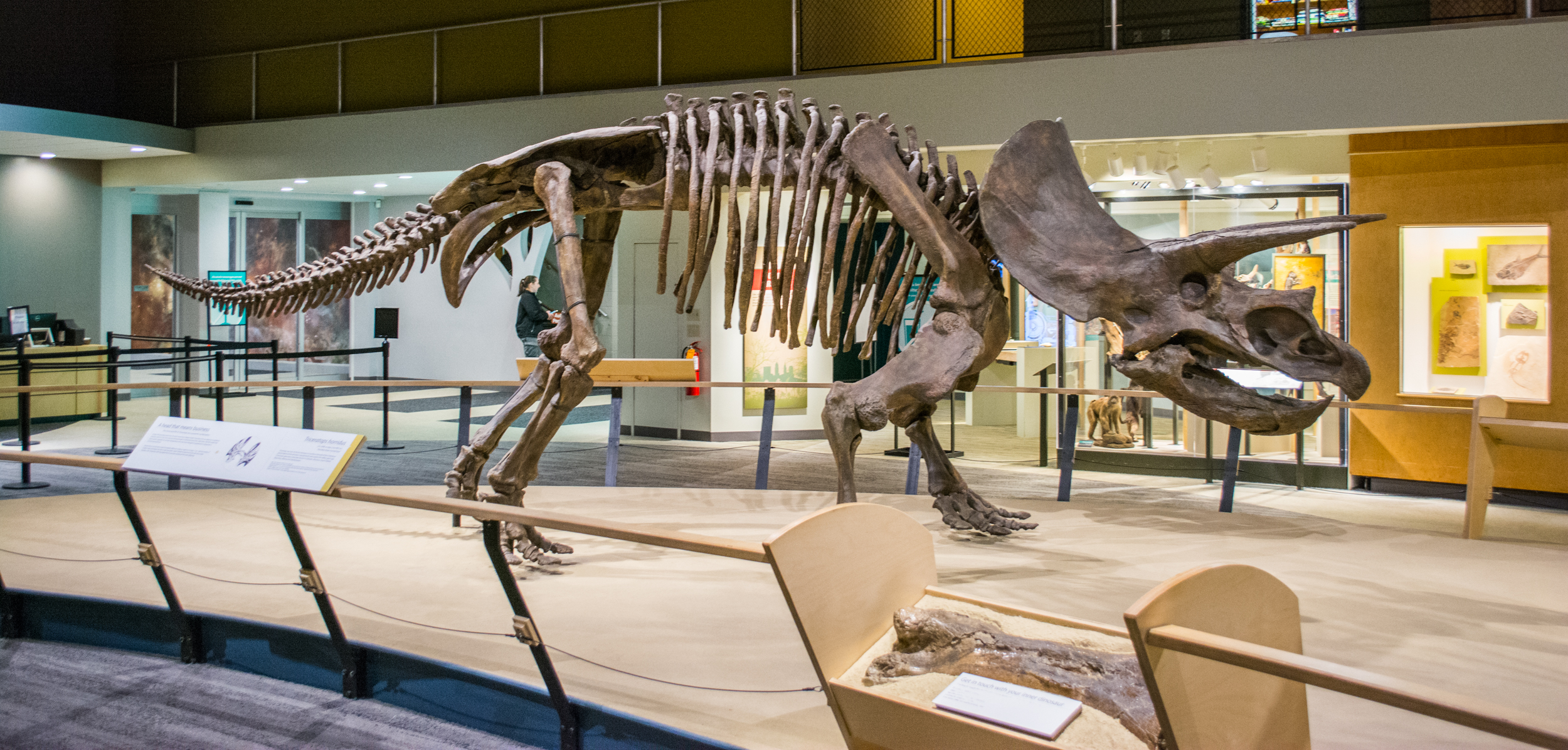
A computer-assisted cast of the historical composite nicknamed Hatcher, posed beneath the Nation's T. rex. The 1905 original combined fossils from ten individuals; those fragile bones are now protected in the research collection.
Leiden, Netherlands
Research collection of five associated T. horridus individuals excavated in Wyoming and represented by more than 1,200 original bones and fragments, supplemented with reconstructed elements for mounting. The herd left Leiden after August 2025, is touring internationally with Natural History Museum Abu Dhabi as its first stop, and is expected back from 2030.
A research repository is not necessarily a public exhibit. Loan and display status can change, so check with the institution before visiting.
Media record
Evidence
Othniel Charles Marsh · American Journal of Science · 1889
Open sourceJohn Bell Hatcher · U.S. Geological Survey Monograph 49 · 1907
Open sourceJohn R. Horner, Mark B. Goodwin · Proceedings of the Royal Society B · 2006
Open sourceJohn B. Scannella, Denver W. Fowler, Mark B. Goodwin, John R. Horner · Proceedings of the National Academy of Sciences · 2014
Open sourceNicholas R. Longrich, Daniel J. Field · PLOS ONE · 2012
Open sourceSmithsonian Institution · 2019
Open sourceNaturalis Biodiversity Center
Open source