Pinhorn Provincial Grazing Reserve fossil region
Milk River badlands, southern Alberta, Canada
Oldman Formation
regional marker
Pronunciation: WEN-dee-SER-ah-tops pin-HOR-nen-sis
A richly ornamented early centrosaurine from an Alberta bonebed, recognized by broad frill hooks that curl forward over the shield.
Last updated 28 July 2026
Field guide
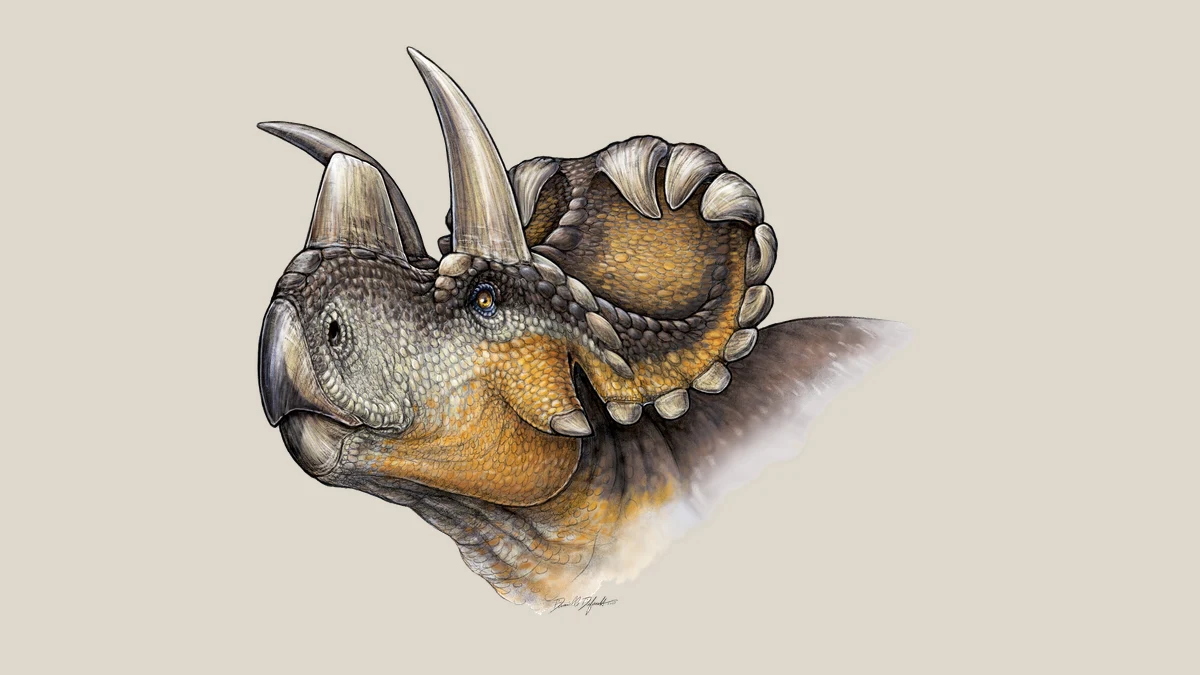
Wendiceratops pinhornensis lived on southern Alberta’s coastal plain about 79 million years ago. More than 200 bones from at least four individuals make it one of the best represented early ceratopsids. Its broad, short frill carried a row of thick processes that curved forward over the bone like hooks. The original description also inferred a large upright nasal horn, potentially one of the earliest of its kind, but the relevant nasal material is incomplete. No secure brow horncores were recovered from the bonebed, so restorations of that area remain especially tentative.
Its fossils occur between approximately 79 and 78.7 million years ago. Values shown here are approximate and reflect the current curated seed dataset.
Form and function
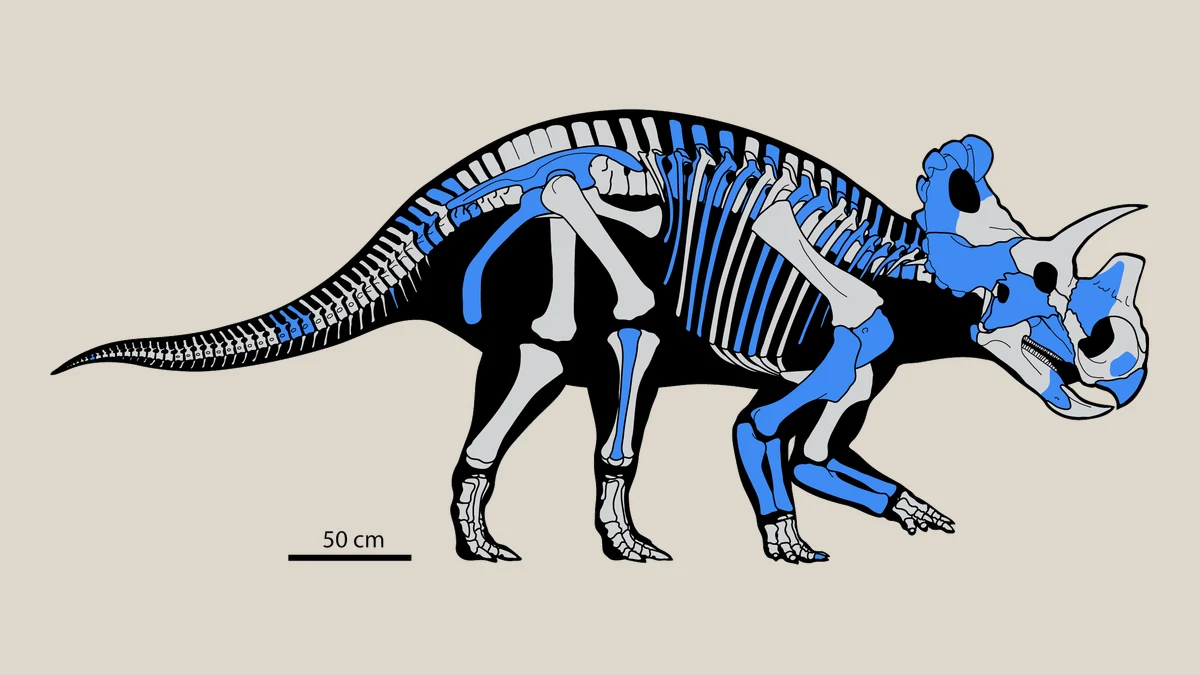
Multiple parietals preserve the species’ diagnostic broad-based P2 and P3 frill ornaments, which bend forward and upward over the rear and side bars. The rostral and parts of the nasal region are known, but the top of the proposed nasal horn is missing. Skull pieces include jaws and teeth, while the bonebed also yielded vertebrae, ribs, shoulder and pelvic elements and limb bones from adult-sized and juvenile-sized animals. A 2023 study documented this postcranial sample in detail and identified a broad, rectangular end of the ischium among its distinctive features.
Evolutionary position
This simplified classification path shows one placement from Dinosauria to this species. Each step is clickable, and other analyses may support alternative relationships.
Open interactive positionScale
Simplified length comparison using preferred dataset estimates; body shape and posture are not represented.
Scientific record
Fossil hunter Wendy Sloboda discovered the bonebed in Pinhorn Provincial Grazing Reserve in 2010. Royal Ontario Museum and Cleveland Museum of Natural History teams led by David Evans and Michael Ryan excavated it during the following field seasons. Evans and Ryan named Wendiceratops pinhornensis in 2015, selecting right parietal TMP 2011.051.0009 as the holotype. The genus honours Sloboda, while the species name records the Pinhorn region where the fossils were found.
Discovery credit: Wendy Sloboda, Royal Ontario Museum and Cleveland Museum of Natural History field teams.
Naming authors: David C. Evans, Michael J. Ryan.
Palaeoenvironment
The lower Oldman Formation in southern Alberta records river channels and floodplains on the western side of the Western Interior Seaway. Wendiceratops lived in a warm, seasonally wet landscape supporting conifers, flowering plants, ferns and other vegetation. Hadrosaurs, armoured dinosaurs, small herbivores and large theropods inhabited the wider formation. DinoTree uses only a broad Pinhorn regional marker rather than a sensitive quarry coordinate.
The bonebed contains several animals, including adults and a juvenile, showing that multiple Wendiceratops were together or accumulated at one place before burial. Taphonomic work supports a single-species bonebed, but this cannot reveal permanent herd organisation. The elaborate forward-curving frill ornaments probably served in visual communication and may also have affected physical interactions. Its beak and dental batteries identify a plant eater, while exact preferred foods and feeding height remain unknown.
Worth knowing
Fossil distribution
Milk River badlands, southern Alberta, Canada
Oldman Formation
regional marker
Markers are deliberately approximate. They identify published fossil areas without exposing sensitive excavation coordinates.
Open interactive mapFossil specimen record
Drumheller, Canada
Repository of the holotype TMP 2011.051.0009 and the other catalogued Pinhorn bonebed specimens. Individual fossils may not be continuously exhibited.
Toronto, Canada
ROM researchers led the study and the museum has presented a reconstructed Wendiceratops in past exhibitions. Visitors should check current galleries before planning a visit around the display.
A research repository is not necessarily a public exhibit. Loan and display status can change, so check with the institution before visiting.
Media record
Evidence
David C. Evans, Michael J. Ryan · PLOS ONE 10(7), e0130007 · 2015
Open sourceSebastian H. W. Scott, Michael J. Ryan, David C. Evans · The Anatomical Record 306(7), 1824–1841 · 2023
Open sourceRoyal Ontario Museum
Open source