Khuren Dukh fossil region
Choyr Basin, eastern Gobi, Mongolia
Khuren Dukh Formation
regional marker
Pronunciation: ZAH-vah-SEF-ah-lee rin-POH-chay
The oldest definitive and most complete known pachycephalosaur, a sheepdog-sized Mongolian herbivore whose dome developed before its body finished growing.
Last updated 16 July 2026
Field guide
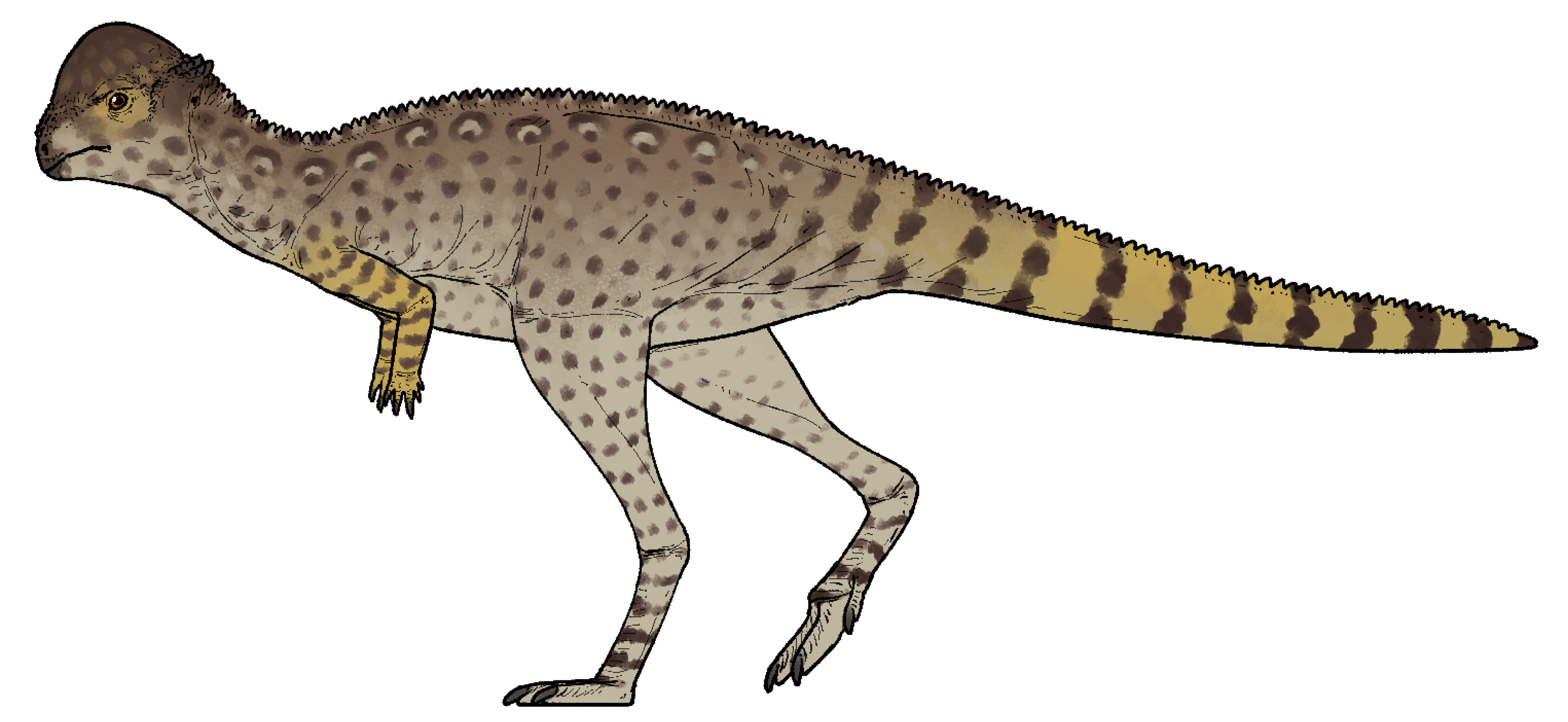
Zavacephale rinpoche is an early-diverging pachycephalosaur from Mongolia's Khuren Dukh Formation. Its holotype preserves about 54 percent of the skeleton by element count, including a nearly complete skull, both hands, a complete tail, ossified tendons and gastroliths. That combination makes it the oldest definitive and most skeletally complete pachycephalosaur yet described. Bone tissue shows that the individual was still growing even though its frontoparietal skull dome was already conspicuous, providing rare direct evidence that dome development preceded full body maturity.
Its fossils occur between approximately 110 and 106 million years ago. Values shown here are approximate and reflect the current curated seed dataset.
Form and function
MPC-D 100/1209 preserves a nearly complete domed skull and much of the postcranial skeleton. The skull has a thickened frontoparietal dome surrounded by smaller ornamented bones, while histology records active growth in the body. Both forelimbs include the first hand bones described for a pachycephalosaur. The complete tail is reinforced by bundles of ossified tendons, and a cluster of polished stones in the body cavity is interpreted as gastroliths. Missing body regions and the juvenile growth stage mean the adult outline and maximum size remain uncertain.
Evolutionary position
This simplified classification path shows one placement from Dinosauria to this species. Each step is clickable, and other analyses may support alternative relationships.
Open interactive positionScale
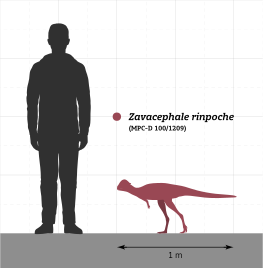
Simplified length comparison using preferred dataset estimates; body shape and posture are not represented.
Scientific record
A joint Mongolian expedition found the articulated skeleton in 2019 in the Khuren Dukh Formation of the Choyr Basin. Tsogtbaatar Chinzorig and seven colleagues named the species in September 2025. Zava derives from a Tibetan word for origin or root and kephale is Greek for head; rinpoche is Tibetan for precious one, referring to the dome emerging from its rock block like a polished jewel. The holotype is held by the Institute of Paleontology of the Mongolian Academy of Sciences in Ulaanbaatar.
Naming authors: Tsogtbaatar Chinzorig, Ryuji Takasaki, Junki Yoshida and 5 coauthors.
Palaeoenvironment
The Khuren Dukh Formation records lakes, rivers and vegetated floodplains within an Early Cretaceous continental basin. The broad regional marker protects the precise quarry while placing the find in the Choyr Basin. Turtles, crocodile-line reptiles, fishes and other dinosaurs are known from the formation, but occurrence in the same rock unit does not prove direct interaction with this individual.
Gastroliths and its ornithischian anatomy support a predominantly plant-based diet. The early growth of the dome is compatible with a role in visual display or social behaviour, and impact-related uses have long been proposed for pachycephalosaurs. Zavacephale itself preserves no healed head injury, trackway or group association that identifies a particular display, combat or social system.
Worth knowing
Fossil distribution
Choyr Basin, eastern Gobi, Mongolia
Khuren Dukh Formation
regional marker
Markers are deliberately approximate. They identify published fossil areas without exposing sensitive excavation coordinates.
Open interactive mapFossil specimen record
Ulaanbaatar, Mongolia
Permanent research repository of the original skull, hands, tail and associated skeleton. The paper verifies curation, but continuous public exhibition is not confirmed.
A research repository is not necessarily a public exhibit. Loan and display status can change, so check with the institution before visiting.
Media record
Evidence
Tsogtbaatar Chinzorig, Ryuji Takasaki, Junki Yoshida and 5 coauthors · Nature 646 · 2025
Open sourceNatural History Museum, London · 2025
Open source