Moreno Hill fossil region
Zuni Basin, west-central New Mexico, United States
Moreno Hill Formation
regional marker
Pronunciation: ZOO-nee-SERRA-tops kris-TOF-er-eye
An early horned dinosaur from New Mexico with paired brow horns and a frill, but without the advanced dental battery of later ceratopsids.
Last updated 2 August 2026
Field guide
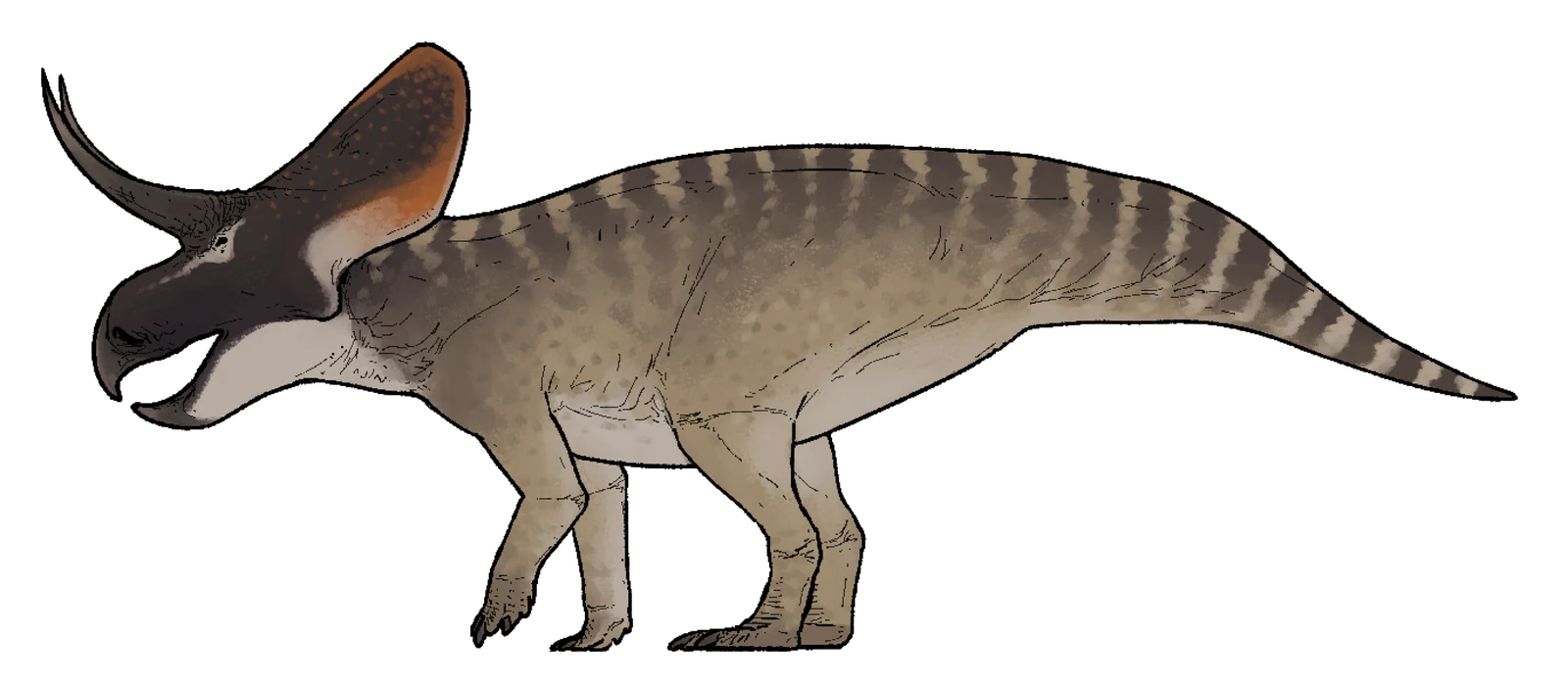
Zuniceratops christopheri was a sheep-sized ceratopsoid from the Turonian Moreno Hill Formation of New Mexico. It combined features seen in earlier neoceratopsians with some of the most recognizable equipment of later horned dinosaurs: a deep beak, a neck frill and paired horns above the eyes. It was nevertheless smaller and more lightly built than Triceratops or Centrosaurus, and its teeth had not yet developed the densely stacked dental batteries of true ceratopsids. Bones from several individuals preserve much of the skull and portions of the skeleton. This combination makes Zuniceratops an important evolutionary intermediate, although incomplete and distorted bones mean that details of its frill and horn development continue to be revised.
Its fossils occur between approximately 93 and 89 million years ago. Values shown here are approximate and reflect the current curated seed dataset.
Form and function
The skull carried a narrow beak, a modest frill and paired horn cores above the eyes; a large nasal horn was absent. The cheek teeth sliced vegetation but did not form the deep continuously replacing dental batteries of ceratopsids. The body was compact and supported by four sturdy limbs, with a comparatively long tail. Because the known skull material comes from more than one individual and includes crushed or incomplete bones, the exact outline and ornamentation of the frill are less certain than the overall horned appearance.
Evolutionary position
This simplified classification path shows one placement from Dinosauria to this species. Each step is clickable, and other analyses may support alternative relationships.
Open interactive positionScale
Simplified length comparison using preferred dataset estimates; body shape and posture are not represented.
Scientific record
Eight-year-old Christopher James Wolfe found the first fossil in 1996 while accompanying a field party in west-central New Mexico. His father, palaeontologist Douglas G. Wolfe, and James I. Kirkland named Zuniceratops christopheri in 1998. The genus honours the Zuni people of the region and the species name honours Christopher. Further material from the Moreno Hill Formation revealed parts of several individuals and prompted a new study of the skull in 2000. Continued preparation also showed why incomplete bones must be interpreted cautiously: an element once included in an early frill reconstruction was later identified as belonging to a different dinosaur.
Discovery credit: Christopher James Wolfe.
Naming authors: Douglas G. Wolfe, James I. Kirkland.
Palaeoenvironment
The Moreno Hill Formation records river channels, floodplains and wooded habitats in western North America near the shore of the Western Interior Seaway. Zuniceratops shared the wider ecosystem with dinosaurs including Suskityrannus, Nothronychus and Jeyawati. The climate and vegetation changed through the formation's history, and the map marker represents the generalized fossil-bearing region rather than a precisely published excavation coordinate.
Zuniceratops cropped vegetation with its beak and processed it with rows of cheek teeth. Its brow horns and frill could have helped with visual display, species recognition or defence, but no injury pattern or direct behavioural trace establishes one particular function. The known fossils represent multiple individuals, yet they do not by themselves demonstrate permanent herding, nesting behaviour or social rank.
Worth knowing
Fossil distribution
Zuni Basin, west-central New Mexico, United States
Moreno Hill Formation
regional marker
Markers are deliberately approximate. They identify published fossil areas without exposing sensitive excavation coordinates.
Open interactive mapFossil specimen record
Albuquerque, United States
The museum published the principal follow-up study of the Zuniceratops skull and maintains New Mexico palaeontology collections. The public sources reviewed do not confirm that original Zuniceratops material is currently on display.
A research repository is not necessarily a public exhibit. Loan and display status can change, so check with the institution before visiting.
Media record
Evidence
Douglas G. Wolfe, James I. Kirkland · Lower and Middle Cretaceous Terrestrial Ecosystems, New Mexico Museum of Natural History and Science Bulletin 14, 303-317 · 1998
Open sourceDouglas G. Wolfe · New Mexico Museum of Natural History and Science Bulletin 17, 92-94 · 2000
Open sourceNatural History Museum, London
Open source